Explore the Watershed
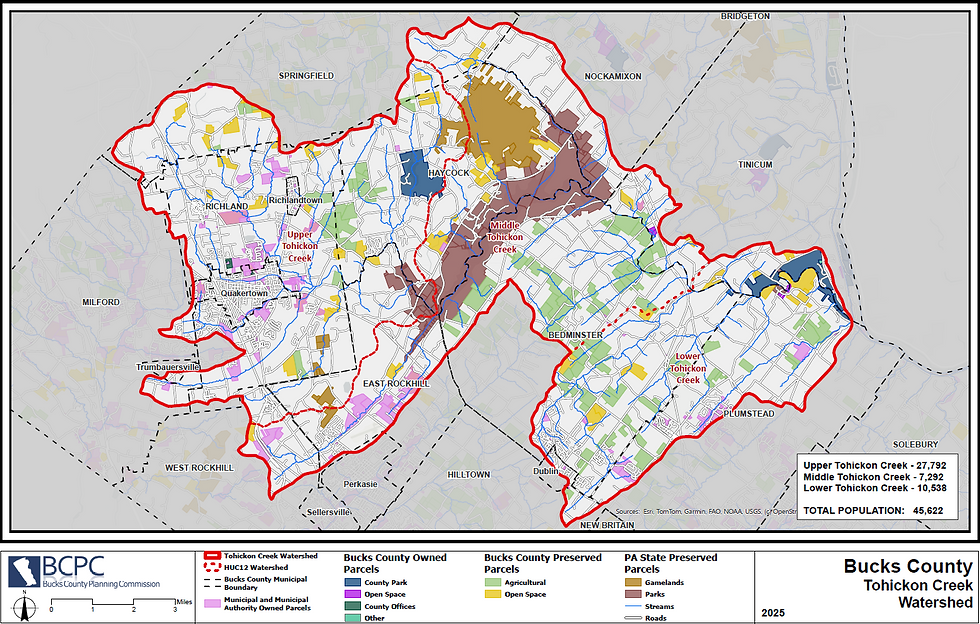

The Tohickon Creek watershed in Bucks County, Pennsylvania covers approximately 112 square miles and is notable for its diverse land uses, rich historical background, and ecological significance. Its population is distributed among rural communities and small boroughs, with Quakertown being the largest settlement along its course. An estimated 45,600 people call the watershed home. Today, recreation, eco-tourism, and agriculture lead local economic activities. The watershed includes portions of Springfield, Richland, Haycock, East Rockhill, Nockamixon, Tinicum, Bedminster, Plumstead Townships, Richlandtown and Quakertown Boroughs.
.webp)
The Tohickon watershed lies in the southern reaches of the Highlands region, spanning 3.4 million acres across Pennsylvania, New Jersey, New York and Connecticut. The Highlands iconic landscape is distinguished by Appalachian ridges, hills and plateaus. It is marked by deciduous and coniferous forests, streams and lakes, and working farms.
Its confluence with the Lower Delaware River is a designated part of the National Wild and Scenic Rivers system, underscoring its recreational and scenic value.
Land based recreation opportunities are plentiful in Lake Nockamixon State Park, Lake Towhee County park, Ralph Stover State Park, High Rocks, and Tohickon Valley County Park. While open water recreation like fishing, birding, and boating are centralized at Lake Nockamixon (1,450-acre reservoir), and Lake Towhee, (50-acre shallow, man-made lake).
The geological foundation is mostly igneous diabase bedrock and shale, accounting for unique habitats and less intensive development due to earth work constraints. High Rocks County Park features a 150-foot sheer rock face with spectacular views of the Tohickon Creek Gorge.
The watershed is predominantly forested (between 57% and 66%), with significant agricultural lands (around 25–37%), limited urban development (about 4%), and scattered wetlands.
Land Use & Ecosystem Significance
Challenges for the Watershed
Water Quality
Water quality declines when pollutants from agriculture, sewage, stormwater runoff, or other land uses enter streams and rivers, increasing nutrients, bacteria, sediment, and toxic substances. These inputs can reduce water clarity, lower dissolved oxygen, and stress aquatic life.
Excess nutrients can trigger algal blooms, sediment can cover food and habitat, and low dissolved oxygen can lead to reduced aquatic biodiversity.
Hydrology Alteration
Hydrology alteration occurs when dams, withdrawals, or other flow controls change the natural timing, volume, and temperature of streamflow. These changes can reduce seasonal flows, warm water temperatures, and release water with low oxygen levels.
Cold-water species may lose suitable habitat, natural spawning cues can be disrupted, and benthic communities often decline when flow patterns no longer support stable stream conditions.
Development Pressure
Development pressure comes from quarries, subdivisions, road expansion, and other land conversion that replaces natural ground cover with impervious surfaces and disturbed soils. This increases runoff, erosion, and pollutant loading while breaking up continuous habitat.
Stormwater runoff can carry oil, metals, and sediment into waterways, while habitat fragmentation can isolate species, reduce canopy cover, and increase streambank instability.
Climate Change
Climate change increases average temperatures and intensifies droughts, heavy rain, and flood events, all of which alter stream conditions and watershed function. Warmer water, less predictable flow, and more extreme events can make ecosystems less resilient.
Aquatic habitat decreases during droughts, floods can scour streambeds and displace organisms, and impairment events may occur more often as water stress becomes harder to recover from.
Infastructure Issues
Fish and other aquatic organisms may be unable to move upstream or downstream, water may back up or accelerate unnaturally, and local erosion or scour can worsen around failing structures.
Infrastructure issues arise when aging bridges, culverts, stormwater systems, or channelized structures no longer match current flow or habitat needs. These structures can constrict streams, block movement, and disrupt natural sediment and flow patterns.


Get in Touch
Use the form below to contact us with questions or to join our community email list to stay in the loop.